Howard Zinn (a bombardier in WWII) explains it perfectly.
Showing posts with label history. Show all posts
Showing posts with label history. Show all posts
Wednesday, May 20, 2009
The Stupidity of War
Labels:
Chris DeCarlo,
history,
howard zinn,
politcs,
wars

Wednesday, February 18, 2009
Will History Repeat Itself?

Franklin Delano Roosevelt
1. World War II.
2. Needs to fix the disasters that had been left behind by World War I.
3. Attempts to fix the economy by applying the “New Deal”.
4. Stock market crashes before FDR comes into office.
5. Millions lose jobs before FDR comes into office.
6. Millions of homes foreclosed before FDR comes into office.
7. Attempts to fix the banks that are about to go out of business, creates the FDIC.
8. Created new jobs.
9. FDR applied the “New Deal” in his “First 100 Days”. This helped to ease the pains of the Great Depression and gave millions of people work.
--------------------------------------------------------------------------------------
Barack Hussein Obama
1. War on terror and the War in Iraq.
2. Needs to fix the disasters of War in Iraq.
3. Attempts to fix the economy by applying the stimulus package.
4. Stock market crumbles in 2008 before Obama comes into office.
5. Millions lose jobs before Obama comes into office.
6. Millions of homes foreclosed before Obama comes into office.
7. Attempt to fix the banks that are about to go out of business.
8. Will he create new jobs?
9. Attempting as of now to apply the stimulus package in order to help ease the pains of this economic crisis. Will he give millions of American jobs?
--------------------------------------------------------------------------------------
The American people elected Franklin D. Roosevelt in 1932 because he promised the country that his candidacy would bring change and a promise of hope. When FDR made his inaugural address, he announced that, “[it is] my firm belief that the only thing we have to fear is fear itself—nameless, unreasoning, unjustified terror which paralyzes needed efforts to convert retreat into advance,” this was addressing the issue of the politicians and the economists that were too afraid or too careful to actually make any radical changes to the government. FDR also addresses that the American nation as of then was in a crisis. He addressed to the nation that we were not in a minor from of a crisis, but we were in a serious economic catastrophe.
The American people elected Barack Obama because he promised the country that he would bring change and a promise of a better future. Barack Obama, when he was addressing the nation, said, “we are in the midst of [a] crisis… Our nation is at war... Our economy is badly weakened… Homes have been lost; jobs shed; businesses shuttered. Our health care is too costly; our schools fail too many; and each day brings further evidence that the ways we use energy strengthen our adversaries and threaten our planet.” Obama also addresses the nation that the economic crisis we are in now is not such a light deal, and that we have to take it very seriously. Both of these Presidents are/were Democrats and have/had very similar situations tied to their belts. With these similarities, will Obama bring change? Or will history repeat itself and bring about another war? No one will know for sure, but until that time comes, all that we can do is compare and contrast both President Barack Obama and President Franklin D. Roosevelt.
War, economic turmoil, and the millions of people without jobs are few of the situations that Barack Obama, our new president, has to deal with. According to the Employment Situation Summary from the Bureau of Labor Statistics, the percentage of unemployed Americans as of this year has been 10.3%, or approximately 15.7 million people. This, however, is not the first time America has gone through these times of serious economic turmoil.
Some 76 years ago, Franklin Delano Roosevelt became the new President of the United States when President Hoover ended his term with the Great Depression. Hoover, much like George W. Bush, had a very low approval rating when he left his seat at the Whitehouse. The times were tough and the Great Depression was taking a huge toll on the American economy. We can surely relate that both the presidents, Roosevelt and Obama, had a tight situation when they began their term(s) in office. President Obama has to deal with both the war in Iraq and the economic troubles in America, while President Roosevelt had to deal with the financial crisis after World War I, the rise of Nazi Germany, World War II, and the ever-endeavoring Great Depression.
--------------------------------------------------------------------------------------
A line for the unemployed. Where the unemployed went daily to get a cup of coffee and some bread.
--------------------------------------------------------------------------------------
Shows a mother and her children suffering through the Great Depression.
--------------------------------------------------------------------------------------
Roosevelt dealt with the Great Depression with his series of plans called the “New Deal”. Some of the programs created, such as the Agricultural Adjustment Act, National Recovery Administration, and the Federal Deposit Insurance Corporation, helped to settle the uneasiness in the American homes. President Obama has the same situation and plan when he is dealing with the economy of today. President Obama has promised the country a national stimulus package, in which the government would do whatever it could to revitalize the economy.
World War II had saved the American economy from crashing completely, and maybe the war in Iraq may do the same, but currently all it has been doing is creating a huge gaping hole in the American markets. Both back then and now, the stock markets have been fluctuating and people have lost their homes due to banks foreclosing on their property. When Obama was getting ready to come into office, the American stock market was plummeting, millions of homes were foreclosing, and millions jobs were being lost. As of today, according to USAToday, about 79% of homes in America are being foreclosed.
--------------------------------------------------------------------------------------
Home foreclosure is one of the most devastating things that can happen to a homeowner.
--------------------------------------------------------------------------------------
When Roosevelt was in office, banks were shutdown because thousands of people took out money in a brief period of time, the stock market was failing completely because of large number of margin buying, jobs were being lost because of overproduction of goods, and millions of homes were foreclosing due to unemployment in addition to no money being in the homeowners’ savings accounts. Getting back into the reasons for the stock market crashing, the markets crashed because of margin buying that most of the investors have done. The Republican controlled government that Hoover ran was a laissez-faire style government, which left the businesses to roam free without government restrictions and interventions. Hoover’s Republican ideas also consisted of low interest rates in banks; to one withdrawing money, it almost seemed like getting the money free of charge. This low interest plan is all well and good if the market stayed at the bull market, which is a stock market where the prices were expected to rise steadily. If the market stayed that way, no one would have lost any money, but because the people sold too low and lost money from margin buying, they lost their fortunes and the market fell to a bear market, which is the opposite of a bull market in which the prices are expected to fall. All of these economic problems that Roosevelt had are very distinctly similar to both then and now.
--------------------------------------------------------------------------------------
People gathering in the streets when the stock markets crashed in 1929.
--------------------------------------------------------------------------------------
The New York Stock exchange today.
--------------------------------------------------------------------------------------
Roosevelt’s Emergency Banking Relief Act created a four-day banking holiday, which stopped all activities of the Federal Reserve System and other banks, credit unions, and loan associations. Over 5,000 banks reopened within three days. This banking holiday helped to give FDR a huge boost of support from the American people. When the bailout started with the Bush administration, many Americans disagreed, questioning whether it was really necessary. The Bush administration claimed that the companies were too large to fail and this caused billions of U.S. dollars to go into the already huge multi-million dollar corporations. As of today, the credit crisis is not getting much better. The bailout plan was supposed to help the American corporations to recuperate, but it looks like all it has done was temporarily create a safety net for the large companies. Loans and interest keeps going up due to the credit crisis that had started in 2007.
--------------------------------------------------------------------------------------


Graph of Wall Street and credit markets drying up due to the shortage of money and the financial crisis.
--------------------------------------------------------------------------------------
When Roosevelt promised change in his presidency, he created administrations to help the development of jobs in the American society. The Works Progress Administration, or the WPA, helped to give out jobs to unemployed Americans. By the spring of 1936, about 3.5 million Americans were on the WPA. Some of the workers were laborers, writers, musicians, actors, and clerks, whom were all given jobs according to their own work fields. Much like times today, many critics reviewed these actions as pointless and that much of the employment was useless work. However, the WPA built roads and public buildings, which helped to create jobs and renew the American society. The WPA employed about 8.5 million people at the cost of about $11 billion after its initial creation. Will this happen with the Obama administration? We can only find out after the President makes his decisions about the economy and the millions upon millions of jobs and homes lost. Will history repeat itself once again? Or will the new frontier of American economy bring about change without drastic warfare? President Obama announced on Monday, February 09, 2009 that the plan that he came into office with is not set in stone. He mentions that he did not plan on spending billions of dollars to start off his administration, but due to the circumstances, the ideas and the plans that he administrated, he had to change by the ebb and flow in order to fit the situation. We can only hope and demand for change, but in reality it is all up to the President to decide what the needs and desires of the American people are.
------------------------------
Note: I will update this post as the Obama administration goes on.
Labels:
Barack Obama,
FDR,
history,
politics,
Ryan Suh,
this day in history
Wednesday, February 4, 2009
The Real Origin of Live Free or Die
According to Wikipedia, New Hampshire's motto comes from...
...a toast written by General John Stark on July 31, 1809. Poor health forced Stark, New Hampshire's most famous soldier of the American Revolutionary War, to decline an invitation to an anniversary reunion of the Battle of Bennington and to send his toast by letter.Stark, I argue, adopted the phrase from the Terror of the French Revolution. In Paris during this time, flags flew with the inscription: "UNITE ET INDIVISIBILITE DE LA REPUBLIQUE, LIBERTI, EGALITE, FREATERNITE, OU LA MORT." In English, it's: unity and indivisibility of the republic, liberty, equality, fraternity or death." Safe to say that's an intricate version of "live free or die."
Labels:
fun facts,
Glen Maganzini,
history,
live free or die,
opinion
Wednesday, August 20, 2008
Top Tan List: My Posts

This being my second-to-last day here, I thought it'd be the perfect time to look back. Consider these posts, presented in chronological order, my greatest hits. Consider this post the CD Review.
About us...
As the site evolved, something it will always do, this post got bigger. Our purpose, however, remains the same: to give you all the news you need to know. Chris Morrill and I started this blog because Spin wasn't doing that job very well. Nowadays, the incompetence of famous corporate outlets justifies this independent journal.
A Night with the Guys and Dolls of the Drama Club
Behold, my first journalistic endeavor that wasn't an opinion piece! Desperate to glimpse behind the scenes of the 2006 spring musical, I went to the dressing room, without anybody's permission, during the intermission and right after the final bow. Advice to aspiring reporters: don't do that.
My day at the TV Barbecue
Over these past few years, my posts have gotten a bit more formal, professional. I would never write in such a casual style as this. But hey, at least I wasn't just posting the Item's top story verbatim. Again.
The grass has grown...
I never thought I'd see a supermarket across from my piano teacher's house. I've since bought groceries there constantly, since it's a five minute walk from my house. On the grand opening, however, I wasn't so sure if this big new building was a good thing. Check out my 16-year-old self's quest to answer that question...and get some free stuff.
Étudiant, Spin/Outlook news
Chris Morrill and I didn't just want to give W.H.S. students an alternative to Spin, which is what this blog originally was. We wanted to improve the damn thing, too. Here's a look at how we did that. We didn't get exactly what we wanted, but the paper appears to have a bit more quality control. Once thing hasn't changed: Glen Maganzini is still amazing.
Student Spotlight: Peter Costa
Here's a kind of piece I should have done more of. Get on it, Étudiants. Interviews are the heart of journalism, especially the informative conversations like these.
Halloween controversy at WHS
It's not so rare for W.H.S. to be accused of stepping over the boundaries. Ms. Freedman caused a bit of a stir with a Halloween announcement. Here are the reactions of Tim Cushing, Andrew Fallon, and a couple others.
Étudiant Éxclusive Senior Show Scoop!
Back in the fall, kids weren't too happy that there'd be no play in the senior show. Come March, however, the many skits made up for it. By the way...
Young Republicans of W.H.S.
I wasn't too sure how seriously to take this club. The school sure seemed to consider it a joke. I would have liked to see some political clubs. Get on it, Étudiants.
Iraq vet talks to juniors
For some time, I supported staying the course because an Iraq vet did. Then I realized that the troops are just as divided over Iraq as the rest of us are. But things have gotten better over the last few months, so let's hope they come home soon.
Darfur survivor visits WHS
Many learned about the Darfur conflict for the first time at this assembly. I've been following the story for more than a year now, and meeting Marwa gave me a better understanding of what's going on. Bless her, and big thanks to the school.
Concert Review: Billy Joel
Billy Joel is one of the top ten acts to see live before you die. He's a born entertainer, and put on one of the best shows I've ever seen. Hell, even if you don't like the guy, go just to see Chainsaw sing "Highway to Hell"!
Chris, Ben, Glen
The Étudiant wouldn't be nearly as good as it is without the others. This video demonstrates what it's like to work with them: a blast. My baby's in good hands.
Labels:
Ben Tan,
history,
Narcissism,
Wakefield Étudiant
Saturday, August 9, 2008
Remember These Losers?

You can see Anthony Guardia, then a W.H.S. student seemingly filming for TV?, on the right side.
A little less than six years ago, the Creativity Movement (those KKK-esque bastards) came to the Beebe Library to spread their word. The movement created quite a stir in Wakefield: there were protesters in the square punching and spitting on members.
Where were you on that day?
Glen: I was on the sidelines during a Pop Warner football game. I broke my arm about a month before and I was just cheering on my fellow teammates. A few guys told me that there were white supremacists down town.
Chris: I was bowling and after I finished my third string (which was rushed!) we headed back to the DeCarlo house for some good old fashioned Lean Pockets!
Friday, August 8, 2008
The Pledge of Allegiance
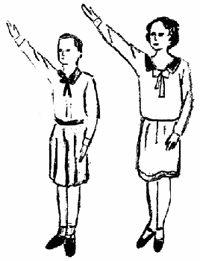
From its inception, in 1892, the Pledge has been a slavish ritual of devotion to the state, wholly inappropriate for a free people. It was written by Francis Bellamy, a Christian Socialist pushed out of his post as a Baptist minister for delivering pulpit-pounding sermons on such topics as "Jesus the Socialist." Bellamy was devoted to the ideas of his more-famous cousin Edward Bellamy, author of the 1888 utopian novel Looking Backward. Looking Backward describes the future United States as a regimented worker's paradise where everyone has equal incomes, and men are drafted into the country's "industrial army" at the age of 21, serving in the jobs assigned them by the state...Bellamy's book inspired a movement of "Nationalist Clubs," whose members campaigned for a government takeover of the economy. A few years before he wrote the Pledge of Allegiance, Francis Bellamy became a founding member of Boston's first Nationalist Club.... - Cato InstituteDon't forget about the recommended salute:
Labels:
flags,
Glen Maganzini,
history,
national news,
pledge of allegiance
Monday, July 21, 2008
This Day In History: July 21
Today's Highlight in History:Courtesy of Edwin1961 at the catholic.com forums
On July 21, 1861, the first Battle of Bull Run was fought at Manassas, Va., resulting in a Confederate victory.
On this date:
In 1831, Leopold I was proclaimed King of the Belgians.
In 1925, the so-called "Monkey Trial" ended in Dayton, Tenn., with John T. Scopes convicted of violating state law for teaching Darwin's Theory of Evolution. (The conviction was later overturned on a technicality.)
In 1930, President Hoover signed an executive order establishing the Veterans Administration.
In 1944, American forces landed on Guam during World War II.
In 1949, the U.S. Senate ratified the North Atlantic Treaty.
In 1954, the Geneva Conference concluded with accords dividing Vietnam into northern and southern entities.
In 1955, during a summit in Geneva, President Eisenhower presented his "open skies" proposal under which the U.S. and the Soviet Union would trade information on each other's military facilities and allow aerial reconnaissance.
In 1961, Capt. Virgil "Gus" Grissom became the second American to rocket into a suborbital pattern around the Earth, flying aboard the Liberty Bell 7.
In 1969, Apollo 11 astronauts Neil Armstrong and Edwin "Buzz" Aldrin blasted off from the moon aboard the lunar module.
In 1980, draft registration began in the United States for 19- and 20-year-old men.
Ten years ago: President Clinton announced a crackdown on nursing homes that were lax about quality and on states that were doing a poor job of regulating them. The Pentagon said it found no evidence to support allegations in a CNN report that U.S. troops had used nerve gas during a 1970 operation in Laos designed to hunt down American defectors. Astronaut Alan Shepard died in Monterey, Calif., at age 74. Actor Robert Young died in Westlake Village, Calif., at age 91.
Five years ago: President Bush said he was working to persuade more nations to help in Iraq. Carlton Dotson Jr., the roommate of missing Baylor basketball player Patrick Dennehy, was arrested and charged with Dennehy's murder. (Dotson later pleaded guilty and was sentenced to 35 years in prison.)
One year ago: Doctors removed five small growths from President Bush's colon after he temporarily transferred the powers of his office to Vice President Dick Cheney under the rarely invoked 25th Amendment. Ruediger Diedrich, one of two Germans kidnapped in southern Afghanistan on July 18, was found dead. David Beckham made his debut with the Los Angeles Galaxy in front of a sellout crowd of 27,000. (Beckham got into the exhibition game in the 78th minute of Chelsea's 1-0 victory.) "Harry Potter and the Deathly Hallows," the final volume of the wizard series by J.K. Rowling, went on sale.
Today's Birthdays: Singer Kay Starr is 86. Movie director Norman Jewison is 82. Actor Paul Burke is 82. Former Attorney General Janet Reno is 70. Actress Patricia Elliott is 66. Actor David Downing is 65. Actor Edward Herrmann is 65. Actor Leigh Lawson is 63. Actor Wendell Burton is 61. Actor Art Hindle is 60. Singer Yusuf Islam (formerly Cat Stevens) is 60. Cartoonist Garry Trudeau is 60. Comedian-actor Robin Williams is 57. Rock singer-musician Eric Bazilian (The Hooters) is 55. Comedian Jon Lovitz is 51. Actor Lance Guest is 48. Actor Matt Mulhern is 48. Comedian Greg Behrendt is 45. Rock musician Koen Lieckens (K's Choice) is 42. Rock singer Emerson Hart is 39. Country singer Paul Brandt is 36. Actress Ali Landry is 35. Actor Josh Hartnett is 30. Contemporary Christian singer Brandon Heath is 30. Reggae singer Damian Marley is 30. Country singer Brad Mates (Emerson Drive) is 30. Singer Blake Lewis ("American Idol") is 27. Actress Vanessa Lengies is 23. Actor Jamie Waylett ("Harry Potter" films) is 19.
Thought for Today: "This is the final test of a gentleman: His respect for those who can be of no possible service to him." — William Lyon Phelps, American educator (1865-1943)
Labels:
Glen Maganzini,
history,
this day in history,
world news
Sunday, July 20, 2008
This Day In History: July 20
Today's Highlight in History:Courtesy of Edwin1961 of the Catholic.com forums
On July 20, 1969, Apollo 11 astronauts Neil Armstrong and Edwin "Buzz" Aldrin became the first men to walk on the moon as they stepped out of their lunar module.
On this date:
In 1810, Colombia declared independence from Spain.
In 1861, the Congress of the Confederate States began holding sessions in Richmond, Va.
In 1871, British Columbia entered Confederation as a Canadian province.
In 1917, the draft lottery in World War I went into operation.
In 1944, an attempt by a group of German officials to assassinate Adolf Hitler with a bomb failed as the explosion at Hitler's Rastenburg headquarters only wounded the Nazi leader.
In 1944, President Roosevelt was nominated for an unprecedented fourth term of office at the Democratic convention in Chicago.
In 1976, America's Viking 1 robot spacecraft made a successful, first-ever landing on Mars.
In 1977, a flash flood hit Johnstown, Pa., killing more than 80 people and causing $350 million in damage.
In 1988, Massachusetts Gov. Michael Dukakis received the Democratic presidential nomination at the party's convention in Atlanta.
In 1988, Iranian leader Ayatollah Khomeini accepted a truce with Iraq, even though he said the decision was like drinking poison.
Ten years ago: Russia won an $11.2 billion loan from the International Monetary Fund to help avert the devaluation of its currency. A smoky fire broke out aboard the cruise ship Ecstasy just 2 miles from the Florida shore, forcing the ship's return to port.
Five years ago: Gen. John Abizaid, the top commander of coalition forces in Iraq, predicted that resistance to U.S. forces in Iraq would grow in coming months as progress was made in creating a new government to replace the dictatorial regime of Saddam Hussein. President Bush welcomed Italian Premier Silvio Berlusconi to his Texas ranch for a two-day visit. Ben Curtis, an unknown PGA Tour rookie in his first major championship, won the British Open.
One year ago: President Bush signed an executive order prohibiting cruel and inhuman treatment, including humiliation or denigration of religious beliefs, in the detention and interrogation of terrorism suspects. Tammy Faye Messner, who as Tammy Faye Bakker helped her husband, Jim, build a multimillion-dollar evangelism empire, then watched it collapse in disgrace, died at age 65 near Kansas City, Mo.
Today's Birthdays: Actress-singer Sally Ann Howes is 78. Rockabilly singer Sleepy LaBeef is 73. Sen. Barbara A. Mikulski, D-Md., is 72. Actress Diana Rigg is 70. Rock musician John Lodge (The Moody Blues) is 65. Country singer T.G. Sheppard is 64. Singer Kim Carnes is 63. Rock musician Carlos Santana is 61. Rock musician Paul Cook (The Sex Pistols, Man Raze) is 52. Actress Donna Dixon is 51. Rock musician Mick McNeil (Simple Minds) is 50. Country singer Radney Foster is 49. Actor Frank Whaley is 45. Rock singer Chris Cornell is 44. Rock musician Stone Gossard (Pearl Jam) is 42. Actor Reed Diamond is 41. Actor Josh Holloway ("Lost") is 39. Singer Vitamin C is 39. Actor Simon Rex is 34. Actress Judy Greer is 33. Actor Charlie Korsmo is 30. Singer Elliott Yamin ("American Idol") is 30. Actor John Francis Daley is 23. Country singer-professional dancer Julianne Hough is 20. Actress Billi Bruno is 12.
Thought for Today: "No man can resolve himself into Heaven." — Dwight L. Moody, American evangelist (1837-1899)
Labels:
Glen Maganzini,
history,
this day in history
Friday, July 4, 2008
What If There Wasn't a War on Drugs?
I'll admit, this is a crappy "what if?" due to poor planning and procrastination lol. However, I think the first half, the background and the premise is educational. So, basically discard the "what if?" for now.
In the 1960s, recreational drug use had reached an all time high among Americans. Drug abuse was and still is considered a grave danger in American society; and during this tumultuous time period adolescents found a distinct pleasure in intoxicating themselves as a form of rebellion and escape. The youth’s opponents: parents, teachers, basically all forms of authority viewed this behavior as a severe threat to traditional morals and attitudes, but more importantly the very future of America. The big question became: how do we stop our citizens, children especially, from doing drugs? Some said more treatment and rehabilitation programs. Others wanted stricter law enforcement. At the time, many thought problems with dangerous drugs was a new issue. In fact, it was the contrary. Drug use and its prohibition had been a prevalent issue in the United States for over a century.
Prohibitionist laws first sprouted up towards the end of the nineteenth century. These early laws were at the local and state levels. They did not completely prohibit the use of any modern, illicit drugs; however they did place restrictions on the commerce of marijuana, opium, and cocaine. According to Southern California Judge James P. Gray, they were “…fundamentally racist laws aimed at perceived threats to white women from drug usage by black, Mexican, and Chinese men, respectively.” These laws implied that under the influence of illicit substances, these minorities would attack women.
The first real prohibitionist law to tackle illicit drugs was the Pure Food and Drug Act of 1906. During this time period cocaine and morphine were used in patent medicines, substances made to cure practically every ailment a person had. As a result, drug addiction became widespread. The Pure Food and Drug Act did not criminalize any of the aforementioned drugs, but now every medication on the market was accompanied by a label describing its contents. Following the act, amendments were released, stating that the labels must inform the consumer about the power of the substances. Subsequently, less people purchased these products. The Pure Food and Drug Act clearly prevented consumers from taking certain dangerous drugs and becoming addicts. However, there were still a large amount of people who were already addicts. 1919’s Webb v. United States the Supreme Court made matters worse for addicts. Judge James P. Gray claims, “…that it was illegal for doctors to dispense prescription drugs to alleviate the symptoms of narcotics withdrawal…” Gray believes this is the beginning of the Drug Prohibition that still exists today. Following the decision, people (mostly addicts) committed crimes to get a hold of the drugs, because they could no longer be prescribed them. As a result, a black market emerged, which meant that drugs were more expensive and more harmful than ever before.
Perhaps the biggest prohibition was the prohibition of alcohol by the Eighteenth Amendment on January 16, 1920. It lasted until 1933, when the Twenty-First Amendment repealed it. During this era, crime skyrocketed in the United States. In these years, there was an increase of over ten million dollars in federal spending on law enforcement and an increase in federal prison inmates by 9,000. Two-thirds of these inmates were arrested for mere alcohol and drug offenses. Another important prohibition was the prohibition of Marijuana. Just like the earlier drug laws, this was heavily associated with racism. In the 1920s, America was witnessing countless Mexicans immigrate into the country. With them came horror stories of violent outbursts due to marijuana consumption. These tales were untrue and created a great racial stereotype of Mexicans.
Harry J. Angslinger, commissioner of the United States Bureau of Narcotics, was an adamant crusader for the prohibition of Marijuana. Anslinger should be held responsible for people being uneducated about drugs. His Bureau of Narcotics was closely associated with the production of the 1936 film Reefer Madness, which popularized ridiculous urban legends about Marijuana and its users. For example, an infamous line from the film states, “one puff of pot can lead clean-cut teenagers down the road to insanity, criminality, and death.” Unfortunately, these tactics actually worked. Numerous states passed laws prohibiting marijuana. This eventually culminated with Congress’ passing of the Marijuana Tax Act of 1937. This piece of legislation did not actually prohibit the drug. Instead, it required those who prescribe, sell, grow, import, or manufacture it to pay a licensing fee. However, this essentially wiped out its market. There was a tax of $100 per ounce for any unlicensed transactions with the drug.
In the decades that followed, the presidents of the United States passed “get tough” laws, which only had detrimental effects on society. With these laws, all illegal substances were placed in the same category and there were unsurprisingly little to no positive results. Subsequently, Congress passed even stricter laws. For example, the Boggs Act of 1951 and the Narcotics Control Act of 1956 increased the sentencing for any illicit drug offense. During the 1960s, Marijuana use became more acceptable, and as a result an increasing amount of adolescents began using the substance, amongst other illicit substances such as LSD, which also became widely popular during this decade. President of the United States, Richard M. Nixon made it his mission to end drug abuse amongst Americans, particularly the youth. He called this ambitious plan the War on Drugs, becoming the first and only U.S. president to formally wage a “War on Drugs.” Now, we are over thirty years into this Drug War and the big question is: has it been successful? Drug abuse and trafficking still exist; people still commit petty crimes to attain drugs and billions of dollars are spent each year on this war. If the War on Drugs had never been created, millions of non-violent drug users could walk freely, billions of tax dollars would not be flushed down the drain, there would be less crime, therefore less prisons, and overall America would be freer.
On June 17, 1971, United States President Richard M. Nixon, at a press conference, declared drug abuse as “public enemy number one.” This was the official beginning of the current War on Drugs. Soon, the Special Action Office for Drug Abuse Prevention (SAODAP) was created. It was headed by Dr. Jerome Jaffe, a leading Methadone treatment Specialist. It should be noted that from the beginning of the drug war up until the present, only during Nixon’s presidency was the funding for treatment greater than the funding for law enforcement. In July of 1973, Nixon formed his “super agency” the Drug Enforcement Administration (DEA). The DEA was created to effectively solve every aspect of the drug issue. It was made up of members of the CIA, BNDD, and the ODALE. Despite the DEA’s great efforts, drug abuse remained a constant problem in America.
Along with drug use increasing, so did federal prisons to incarcerate the drug offenders. Many critics of the drug war call this a “Prison-Industrial Complex.” Justice William A. Newsom made the following comments:
“One result of the attempt to control drug use with heavy penalties is, of course, an increase in the price of drugs, which assures an increase in crime both random and organized. Viewed in this context, the war on drugs, besides being laughably inept and already visibly lost, is in fact the driving force behind serious crime.
From shoplifting to prostitution, through burglary and armed robbery on up the scale to murder, the great majority of serious crimes in California are drug-related; that is to say caused not by the perpetrator’s ingestion of drugs, but by his or her need to obtain the large amounts of money necessary to purchase drugs on the street for personal use.”
In 1973, the same year of the formation of the DEA, The United States contained 330,400 state and federal prisons. In ten years that number doubled; in twenty years it had more than doubled again, reaching 1,408,685 prisons. According to Judge James P. Gray, “By June 30, 1996, the number of men and women incarcerated in the United States in both the state and federal systems was 1,630,940, and by the end of 1998 the number was 1.8 million.” Strangely, during this time period, crime had decreased and yet drug arrests had increased. Many of these incarcerations could be attributed to the inclusion of mandatory minimum sentences.
On October 27, 1986, United States President Ronald Reagan signed the Anti-Drug Abuse Act of 1986. Under this act, $1.7 billion was spent to combat the drug epidemic, $87 million for the construction of more prisons, $200 million for drug education, and $241 million for treatment. However, the act’s most controversial and certainly most substantial portion was the formation of mandatory minimum sentences. This severely increased the penalties for drug offenses, often just for the simple possession of illicit drugs. For example, if one was arrested for possession of five kilograms of cocaine or just one kilogram of heroin, he or she received at least ten years imprisonment. At the time, the crack epidemic had just surfaced, and as a result laws against the drug were far more stringent. For example, if a person was arrested for selling five grams of crack they automatically received five years in prison as a mandatory sentence. These mandatory minimum sentences received harsh criticism because the sentences for crack were far greater than those for cocaine. Critics say this causes a massive racial disparity in the prison population. In fact, in May of 1995 a report was released by The United States Sentencing Commission, stating that there was a racial disparity between crack and cocaine sentencing. The Commission wanted to erase the discrepancy as much as possible; unfortunately Congress did not agree and for the first time in history they overrode the Commission’s proposal. 1988’s Anti-Drug Abuse Act brought even stricter law enforcement for drugs. According to Judge James P. Gray, “… [it] further expanded federal offenses to include the distribution of drugs within one hundred feet of playgrounds, parks, youth centers, swimming pools, and video arcades.”
In 1989, President George Bush created the Office of National Drug Control Policy (ONDCP). Bush made William Bennett the leader of the ONDCP. As “Drug Czar” he created a plan of “denormaliztaion.” Essentially his mission was to make drug use socially taboo. Under Bennett’s leadership, federal spending for law enforcement and treatment increased greatly. Unsurprisingly, treatment was less than one-third of the total budget. One year later, Bush added $1.2 billion to the War on Drugs’ budget, which included a 50% rise in military spending. The ONDCP’s budget has always been an issue amongst drug war critics. Judge Gray claims,
“As of fiscal year 1999, the Office of National Drug Control Policy, by itself, was overseeing a federal drug control budget of $17.8 billion ( in nine separate appropriations bills), plus an additional $1 billion for the National Youth Anti-Drug Media Campaign, $143.5 million for the Drug-Free Communities Program, and $184 million for the High-Intensity Drug Trafficking Area Program. That budget was increased again to $19.2 billion for fiscal year 2000….It is up to us as caring citizens, taxpayers, and voters to make the government move forward to a more rational, workable, and as good fortune would have it, vastly less expensive national drug policy.”
The 1990s brought even stricter laws for drug offenses. Some major examples include the Crime Bill of 1994, which in some cases instituted capital punishment for drug dealing; mandatory sentences ranged from twenty years to life. 1998’s Higher Education Act determined that those convicted of marijuana possession automatically lose federal aid for college. What it is even more disturbing, is the fact that this form of ineligibility does not exist for worse offenses, such as rape, robbery, or manslaughter. It is apparent that under our current drug policy we are creating overcrowded prisons. Judge Gray makes this excellent point:
“…about 18 million Americans used marijuana at least once during the year 1997…During that same year, the United States had about 1.7 million people behind bars under badly overcrowded conditions. Since it is immediately obvious that we cannot put 18 million people in jail, even if we were to agree that this was a good idea, why are we following this course? Yet people who did nothing but smoke some marijuana are sent to state prison every day to serve years of time. How can that happen?”
In short, the War on Drugs has been a massive failure on various levels. Unfortunately, it still exists today, and in fact costs more than it ever has: over twenty-two billion dollars, just this year alone. Is it really worth that much money? Can this war be won? Well, the answers to those questions are not facts, of course. Although, if one observes the drug war from its inception in 1971 up until the present, it is clear that the goals President Richard Nixon sent out to achieve have not been won and the overall drug problem in America has steadily become worse. With each decade, stricter laws have been made, more prisons have been built, and drugs have always been available. With sufficient education, any reasonable person should be able to see why our drug policy deeply needs reformation. If this War on Drugs had never existed the United States would be a much better place; there would be less criminals, less prisoners, less taxes, and even less drug use.
Supposedly, the War on Drugs’ primary aim was ending drug use in America. Unfortunately, over the years we have realized there is little to no chance that this will occur. However, we can always reduce the amount of people taking drugs. Instead of focusing our energy on locking up drug offenders (mostly non-violent drug users) we could spend the money on better treatment and education. People would be more informed about the dangers of drugs and this most likely would prevent some from using them. If there was no prohibition of drugs, the money the federal government spends on law enforcement could be used to fund more rehabilitation and more education. As a result, there would be less Americans arrested each year. One of the biggest criticisms of the drug war is the rise of prisons being built to house millions of drug offenders. Overtime, the amount of prisons increased and of course this increased federal government spending, therefore, increasing taxes. This would no longer be an issue, because the amount of prisoners would decrease, therefore the amount of prisons would also decrease.
Without the War on Drugs many pieces of legislation that strengthened law enforcement would no longer exist. A major example is the Anti-Drug Abuse Act of 1986, which created the extremely detrimental mandatory minimum sentences. To this day these sentences are applied to many incarcerations for drug offenses. If this act had never been passed and as a result these mandatory minimum sentences did not exist, then countless drug sentences would be severely reduced. It should also be noted that the racial disparity in the prison population would vanish, because there would be no difference in the sentencing for crack and cocaine. Another example is the Higher Education Act of 1998, which disqualified youths from getting federal aid for college if they were convicted of marijuana possession. Perhaps, if this act had not been passed, then more youths could attend college and receive a higher education.
In conclusion, the War on Drugs, like every form of prohibition does not work. There are countless problems with our drug policy in America. Once again the main flaws are the imprisonment of non-violent drug users, the overcrowding of prisons, and the overall expense of the drug war’s budget. There are very little positive effects of this system, but there are obviously many negative effects. Drug use has not decreased, crime has not been prevented, in fact the opposite, the drug war secures organized crime. As long as these substances are illegal, there will always be a black market available. Essentially, the United States would be a far greater place if there was not a drug war. Americans need to realize how costly this war is, both financially and emotionally. It is evident, that many of our citizens, mainly parents, are in favor of the drug war because they do not want their children taking drugs. Well, we are thirty-seven years into this war and more drugs are available than ever before; a change is long overdue.
Everything got screwed up when I tried to copy the resources, so I just decided not to include them. If anybody wants to know what they are just ask me. I used Judge James P. Gray's Why Our Drug Laws Have Failed and What We Can Do About It for the most part.
Labels:
Chris DeCarlo,
drug war,
drugs,
history,
national news
What If Prohibition Wasn't Passed?
Prohibition is the name given to a period in the 1920s and early 1930s in which the sale of alcohol was made illegal via the Eighteenth Amendment. Andrew Volstead, a member of the House of Representatives from Minnesota, introduced the eponymous Volstead Act in 1919 along with Anti-Saloon League attorney Wayne Wheeler. The bill was initially vetoed by President Wilson on October 28, 1919, but was overridden by Congress on the same day[1]. The Prohibition movement began as early as the 1600s, but increased greatly in popularity over the next two hundred years. Large groups began to move away from socially criticizing alcohol to denouncing it on a political level as well. After a multi-century struggle, Prohibition was passed much to the delight of millions of Americans. Society was supposed to become more moral and more responsible, but this was not the case. Organized crime was directly tied in to bootlegging and smuggling, two illegal large businesses in the U.S during the 1920s. In addition, corrupt law enforcement officials often condoned the illegal activity because it offered them a chance to profit off of bribes. Also, with alcohol no longer in the public spotlight, people from every town and city began to flee to speakeasies to indulge in their favorite illegal beverage[2]. The amount of speakeasies grew exponentially starting in 1919[3]. Overall, America became a country marred by unlawful doings. Prohibition didn’t end the problem of alcohol; it created more problems than ever before. A country without Prohibition would have been one without the tarnish of mobs, illegal breweries and bars, and bootlegging.
Prohibition causes have been around since the early beginnings of American history. As early as the 1600s, English colonists began to recognize the evils of excessive drinking. With a large presence of alcohol in the colonies, settlers began to realize that excessive drinking wasn’t good; shipments of tens of thousands of galloons of beer and spirits were frequent as supplies were quickly being used up. Plymouth was the first colony to prohibit the sale of spirits in 1633[4]. Other colonies did not follow suit and drinking continued to be commonplace.
In fact, many of the popular religions in early America denounced drinking, but this did not stop the wealthy from opening up taverns and bawdyhouses. Non-alcoholic drinks simply weren’t as reliable as their alcoholic counterparts. Without refrigeration, milk spoiled quickly. Water that was gathered from filthy lakes and streams was unpurified and repugnant. Alcohol, on the other hand, was viewed as beneficial to ones health in addition to being tasty. Distilleries certainly catered to the demand of the colonists; in 1792, there were 2,579 registered distilleries in the U.S[5]. The British, however, were able to exploit the colonist’s need of alcohol following the Revolutionary War. Taxes were levied on liquor as a mode of raising money. Farmers felt the biggest burden so they initiated a massive uprising in the late 1700s. The revolt, known as the Whiskey Rebellion, resulted in fifteen thousand soldiers travelling to Pennsylvania to put to an end the fighting between the tax collectors (British) and the whiskey farmers. Taxes couldn’t stop people from producing alcohol, though, as more than 12,000 distilleries registered between 1792 and 1810[6]. The rise of immigration in the early to mid 1800s normalized drinking even more. Many immigrants came from Europe, where drinking was considered a part of their culture. Once the Germans started migrating en masse to America following the Civil War, lager beer grew in popularity. Large companies and corporations started to specialize in the manufacturing and selling of beer to domestic and foreign markets. Many of the purchasers of beer were saloons.
Saloons and breweries had a very profitable relationship: breweries would provide saloons with unlimited beer, advertising, and loan money. Saloons quickly became associated with none other than their drinkers, who were often lower class men. Since there were more saloons than parks, churches, schools, and hospitals combined, competition was quite high. In order to lure in customers, saloon owners often gave away free lunches[7]. Multitudes fled to saloons to drink to forget about family or work problems. As the popularity of saloons soared, so did the amount of detractors. Anti-saloon propaganda argued against saloons on the basis that men went there to support the saloonkeepers’ children instead of their own (by continually purchasing beverages)[8]. Anti-saloon groups, commonly plated as temperance organizations, advocated for lessening the consumption of alcoholic beverages. Many of them were deeply inspired by the First and Second Great Awakenings that swept the nation in the first half of the 19th century. Some fanatical temperance era physicians went as far as to argue that it wasn’t uncommon for drinkers to randomly explode. These kinds of myths along with the messages of temperance advocates helped sway heavy drinkers away from booze[9]. Groups like the Washingtonians were comprised of men who told others about their departure from alcohol in the hopes that others would stop. These groups were widespread at first in the 1840s, but they quickly diminished and were eventually wholly discontinued. A short time later in the 1850s, the first significant precursor to National Prohibition came.
Maine, in 1851, passed a law which forbade the sale and manufacture of intoxicating liquors. For prohibitionists, this was a great triumph to a longstanding cause. Eleven years later in 1862, President Lincoln signed the Internal Revenue Act which taxed the manufacture of liquor as well as charged saloons an operating fee. State activism for prohibition quickly expanded into the national scene as the National Prohibition Party was founded in 1869. It had two goals: women’s suffrage and prohibition. Women not only wanted rights for themselves, but they also wanted their family life to improve. Husbands wasted invaluable sums of money on drinks and this often had an adverse effect on their jobs and their support of families. Groups like the Women’s Christian Temperance Union and the Women’s Crusade were faith based groups that vocally stressed that taverns and saloons were directly correlated to the separation of men and women in terms of rights. There was a fine line between politely campaigning for prohibition and going too far. Exemplifying the latter was a radical WCTU member named Carry Nation. Nation paraded around Kansas raiding saloons to no end. By the early 1900s, and most especially during World War 1, the issue of prohibition was regularly debated. Prohibitionists reasoned that since many brewers were of German descent, Prohibition and boycott of industry could help win the war on the home front. Despite the overwhelming opposition, the Eighteenth Amendment, which outlawed alcohol, was easily passed in 1919. The early architects of Prohibition did not even begin to contemplate the thought of the movement not working or much worse failing. As soon as the wineries and breweries were shut down and forced to flush out all of their alcohol, the adverse effects of national Prohibition were felt among the masses.
Wild parties roared on throughout the country on the last day of legal drinking, January 16. Before the clock struck 12:00 AM, trucks were well ready for what lay ahead of them as they were filled with bootleg liquor[10]. Not surprisingly, a few of these trucks were snatched by the seizure motivated government. As a result, a black market for alcohol opened up. Millions were without their favorite beverage and millions more wanted to continue drinking independent of how they would get their alcohol in the first place.
Smuggling was not only popular; it was a successful business. Approximately 75% of contraband liquor came via a route from Canada. Short “rum runs” ran from Ontario, more often than not Quebec, to Detroit and neighborhood cities and towns. The Quebecois, by law, were permitted to buy an unlimited supply of alcohol for personal use. At first, harmless fisherman ran the trade, but it wasn’t long until organized criminal organizations took over. These organized gangs had quite a lot of money and paid off bribes to corrupt local officials, who in turn let them run. Way down south in the Caribbean, illegal alcoholic transactions ran rampant. Runners could simply load up their ships from islands like the Bahamas and then sail to New York City without being caught. This all changed when the government diplomatically mandated seizures in foreign islands and commissioned Coast Guard patrol craft[11].
One foible in the Volstead Act was the granting of alcohol prescriptions to patients. A clever exploitation system was set up by George Remus, an infamous bootlegger during the Prohibition Era. Remus was able to purchase thousands of whiskey certificates which granted him quite a surplus of whiskey. He was then able to set up the largest distillery business in America at the time. He then sold whiskey to drug companies under the caveat that they be used for medicinal purposes only. Most drug companies did not follow (Doctor) Remus’ orders; phony prescriptions were given to even the healthiest of men[12].
When the government started to seriously crack down on distilleries and stills (17,000 seized by 1925), bootleggers started to experiment with self-made methods of producing alcohol. Liquid poison wasn’t entirely uncommon as more than 10,000 people perished by 1927. Alcohol was taken from hazardous products such as fabric and antifreeze and used in the distillation process. It is no kidding that alcohol poisoning was likened to “deliberate suicide.” A less painful, less alcoholic “near beer” was produced by creative bootleggers who figured they could manipulate the Eighteenth Amendment provision which allowed for beverages to be sold as long as they contained less than 0.5 percent alcohol. “Near beer” was often closer to real beer than just barely beer. Replacing “near” with real was readily accomplished and barely noticed. Another sly trick was injecting a needle of alcohol into drinks to give it more of a kick. At any rate, these ventures were ostensibly successful. Even beer with a high content of alcohol proved profitable: a bootlegger could make profits of up to $2.50 for each galloon of booze sold[13]. The lower the quality of the alcohol, the higher the revenue was albeit due to counterfeit labels tricking drinkers into thinking that their beverage was a higher proof than it really was. High prices again did not lessen consumer demand.
The heralded stories of underground and illegal drinking have been prevalent, but the numbers and percentages of consumption are relatively unknown. Wet organizations (ones that advocated against Prohibition) often claim that drinking increased significantly while temperance and Prohibition advocates assert that drinking was far less common in the Prohibition era. Such a debate continues today, but no consumption numbers are indicators of the presence of illegal drinking in the 1920s. The 1920s, commonly called The Roaring ‘20s, was a period of rebellion and economic prosperity. Drinking was oft-associated with money and status in society. From the rich to the poor, many made their presence felt at illegal bars known as speakeasies. The number of speakeasies increased by at least six times in New York City alone in the period from 1922 to 1929[14]. From low class shacks to higher end brownstone houses, speakeasies served those who literally “spoke easy”; customers with the right spoken password were allowed in while others were forced to find less popular open door ‘easies. The more expensive speakeasy often featured entertainment, which ranged from relaxing jazz music to recreational table tennis. Saloons formerly consisted of primary men, but speakeasies were populated and, in some cases, maintained by women. Enforcing Prohibition and stopping the spread of speakeasies was not at all easy. Congressman Fiorello La Guardia acknowledged the corrupted nature of speakeasies when he said “In order to enforce prohibition [in New York City], it will require a force of 250,000 men and a force of 250,000 men to police the police.”
The hiring practices of law enforcement agencies such as the Prohibition Bureau were considered highly lenient. Prohibition Administrator admitted so himself when he said in 1927 that “three quarters of the 2500 dry agents are ward heelers [political machine workers] and sycophants named by the politicians.” The enforcers worked for an incredibly low wage, but it is safe to presume that they could accept a year of wages in the form of bribery. “Looking the other way” as it was called gave enforcement officers the chance to gain quite a bit of wealth. On the other hand, there were brutally honest officers who wouldn’t confide to bootleggers and other crooks[15]. The famous couplet of “Izzy” Einstein and Moe Smith often dressed up in a variety of different outfits with the intention searching speakeasies and making arrests. In his hey day, Einstein apprehended close to 5,000 people. They were viewed as good guys in the eyes of the general public, but there were still some who accused them of being dishonest. Some of the most stringent officers used guns and other such weaponry to dismantle bootleggers, gangs, and other such criminals[16]. Their labors were not effectual as many of the criminals had access to far greater weapons and machinery such as machine guns and explosive devices. Overall, a near universal ere amongst the states was that enforcing Prohibition wasn’t something worth doing. By the late 1920s, enforcement was a ridiculously small percentage of state budgets. The ramifications of enforcement were anything but prosperous: nobody wanted to pay enforcers more money, nobody wanted to invest more money into the judicial system for Prohibition, and most of all nobody wanted to increase taxes or take money out of other industries to maintain Prohibition. Thusly, criminal activity reached its peak in the 1920s.
Mobsters had a reputation of specializing in distilling alcohol at this time. Various gangs such as the North Side Gang and the Terrible Gennas surfaced as rivals. Al Capone, the relentless ringleader of the Gennas, was relentless in his attack; hundreds died in gang related activity. Capone used to terror tactics to control the political sphere of Chicago. He was directly responsible for the election of the mayor of Chicago and the state attorney of Illinois. His boss power in Chicago did not last for a long time, however, as he was banished from the public spotlight following the Valentine’s Day Massacre of 1929. Two years later in 1931 was Capone sentenced to eleven years behind bars. His influence and legacy lived on and resonated in other major cities like New York, where a younger generation of mob bosses controlled the illegal alcohol trade.
The unemployment rate started soaring in the 1930s causing many people to question whether Prohibition really worked. An end to Prohibition, in the form of a repeal to the Eighteenth Amendment, was seen as a potential benefit to an otherwise wretched situation. People were beginning to feel the ill aftermaths of the Stock Market Crash and the Great Depression. They argued that legalizing alcohol once again would create (legal) jobs in that industry. The 1932 election was just around the corner and saw two candidates who both denounced Prohibition. Franklin D. Roosevelt and his Democratic Party won the race to the White House and took up ending Prohibition as their first priority. Roosevelt immediately cut funding as well as raised the limit on the percentage of alcohol allowed in beer. Within months, the Twenty-First Amendment was ratified by the necessary thirty-six states.
Prohibition was a national issue which looked to solve the problems of every state in one highly confusing piece of legislature. The American people were forced to live in a supposed structured society that did not include alcohol for thirteen years too many. The issue was not settled in a democratic way and consequently nobody could be entirely appeased. The temperance movement wanted to establish a moral foundation for the country that would bind together the family all whilst wiping out drunkenness. This moral foundation was significantly based upon religion – an integral part of many American’s daily lives. They had a feeling that too much alcohol would spin everything out of control. They did not want to see their children to be ruined by the licentious leech called alcohol. While their efforts were onerous and long, they did not leave much room for discussion. For them, drunkenness was a sin that could not be negotiated in any way shape or form. They were equating drunkenness with sin for nearly three centuries, but to no clear avail until Prohibition. The opposition, those who were against Prohibition, was often comprised of drinkers themselves or activists who believed that morality could not be legislated. They wanted to keep the status quo, which was alcoholic clemency. It wasn’t even that anti-Prohibitionists were anti-religious or anti-moral absolutism. They simply didn’t see the point in banning something that millions upon millions engaged in. For what is certain, both sides of the debate didn’t foresee the disasters of organized crime and corruption that came with the passing of the Prohibition Amendment. Neither side envisioned thousands of speakeasies opening up across the country, neither side envisioned lucrative bootlegging and rum running businesses dominating the country’s economy, and finally neither side envisioned hundreds of deaths due to alcohol poisoning.
All of the aforementioned results of Prohibition would not have been if the Volstead Act was not passed decades ago. The various temperance organizations would still be active in politics today. Surely, their efforts would still go unrewarded; the American people are just beginning to realize the importance of states’ rights in democracy based affairs. Religious institutions to this day still insist that drinking is a sin if done to excess, but these views aren’t reflected in modern day legislation. Gang related activity is still closely connected to illicit behavior such as illegal drug and narcotics trade. If there was no Prohibition, there would be no Al Capone, and there would be no unprecedented rise in mob activity. There is no such thing as legal gang activity and the laws of causality affirm this: there needs to be a cause (Prohibition laws) for an effect (criminal behavior). Prior to 1919 racketeering, the owning of illegal businesses, was unheard of in America. Following the passage of Prohibition, racketeering increased drastically and has continued to over the years. The Racketeer Influenced and Corrupt Organization Act (RICO) wasn’t passed until 1970, long after many mafias and gangs established notability in the United States. With that said, no law or provision today has enough power to stop organized illegal activity from occurring. Men have long found ways of avoiding trouble with the law and this all started with Prohibition.
Many revisionist models of today look back to the 1920s when evaluating current drug policy. They see a link between the alcoholic use in teenagers in the 1920s and the marijuana use in teenagers at the present time. They can see how both were affected by drug prohibition laws. They read about the hundreds of innocent citizens arrested all for just having possession of an illegal substance. They look at the statistics and realize that the one of the highest periods of alcohol consumption in the U.S was from 1916 to 1922 – slightly before and after the passing of the Prohibition Amendment. The overall point is that Prohibition did more harm than good and set the groundwork for years of drug policy failure in the United States alone. Temperance organizations (today, anti-drug organizations) have proven that they can still have a positive effect on the general public (less consumption) without federal backing. Of course the government did not realize this before Prohibition began and still today they haven’t given legalization or decriminalization of drugs a chance.
Whenever ever something is made illegal, there exists an underground scene of illicit trading and smuggling. The Prohibition of alcohol was no different: rum runs were frequent and unproblematic until the government decided to condemn these illicit behaviors and even then corruption took over. The movement was out of control from its very beginning, but hardly anyone ever admitted to this. The most negative consequences of Prohibition still afflict America today. Many wonder why there are gang problems. More than eighty years later, they don’t realize the impact Prohibition had on gangs. With education of the effects of Prohibition, these people, often law makers and politicians, will realize what started it all. As Charles R. Swindoll one said, “We cannot change our past. We can not change the fact that people act in a certain way. We can not change the inevitable.”
[1] Suzanne Lieurance, The Prohibition Era 13-16
[2] The Prohibition Era 65-68
[3] Speakeasies; http://www.legendsofamerica.com/ah-prohibitionspeakeasy.html
[4] History of Alcohol Prohibition; http://www.druglibrary.org/schaffer/LIBRARY/studies/nc/nc2a.htm
[5] The Prohibition Era 21
[6] The Prohibition Era 23
[7] Saloons; http://www.encyclopedia.chicagohistory.org/pages/1110.html
[8] Jeff Hill Defining Moments of Prohibition 12-15 (The Business of Alcohol)
[9] The Prohibition Era 33
[10] Defining Moments in Prohibition 31
[11] Defining Moments in Prohibition 34-38 (Running the River; Rum Row)
[12] Edward Behr Prohibition: Thirteen Years That Changed America 121-128
[13] Defining Moments in Prohibition 41 (“Near Beer” and Real Beer)
[14] The Prohibition Era 76
[15] Digital History; http://www.digitalhistory.uh.edu/database/article_display.cfm?HHID=441
[16] Defining Moments in Prohibition 62-63
Labels:
Glen Maganzini,
history,
literature,
national news
Thursday, July 3, 2008
America is Not A Democracy
Chomsky gives a nice little history lesson here.
Labels:
Chris DeCarlo,
history,
Noam Chomsky
Tuesday, June 24, 2008
This Day In History: June 24
Today's Highlight in History:
On June 24, 1948, Communist forces cut off all land and water routes between West Germany and West Berlin, prompting the western allies to organize the massive Berlin Airlift.
On this date:
In 1314, the forces of Scotland's King Robert I defeated the English in the Battle of Bannockburn.
In 1509, Henry VIII was crowned king of England.
In 1793, the first republican constitution in France was adopted.
In 1807, a grand jury in Richmond, Va., indicted former Vice President Aaron Burr on charges of treason and high misdemeanor (he was later acquitted).
In 1908, the 22nd and 24th president of the United States, Grover Cleveland, died in Princeton, N.J., at age 71.
In 1940, France signed an armistice with Italy during World War II.
In 1948, the Republican National Convention, meeting in Philadelphia, nominated New York Gov. Thomas E. Dewey for president.
In 1968, "Resurrection City," a shantytown constructed as part of the Poor People's March on Washington, D.C., was closed down by authorities.
In 1975, 113 people were killed when an Eastern Airlines Boeing 727 crashed while attempting to land during a thunderstorm at New York's John F. Kennedy International Airport.
In 1983, the space shuttle Challenger — carrying America's first woman in space, Sally K. Ride — coasted to a safe landing at Edwards Air Force Base in California.
Ten years ago: President Clinton left on a nine-day visit to China amid a swirl of controversy over his policy toward the Beijing government. AT&T Corp. struck a deal to buy cable TV giant Tele-Communications for $31.7 billion.
Five years ago: Six British soldiers were killed by Iraqis in a police station in southern Iraq and eight were wounded in a nearby ambush. President Vladimir Putin arrived in London on the first state visit to Britain by a Russian leader since the 19th century. An Air France Concorde bound for a German museum landed in Germany.
One year ago: Ali Hassan al-Majid, Saddam Hussein's cousin known as "Chemical Ali," and two other ex-officials in Saddam's were sentenced by the Iraqi High Tribunal to hang for slaughtering up to 180,000 Kurdish men, women and children two decades earlier. Charles W. Lindberg, one of the U.S. Marines who raised the first American flag over Iwo Jima during World War II, died in Edina, Minn., at age 86.
Today's Birthdays: Actor Al Molinaro is 89. Comedian Jack Carter is 85. Movie director Claude Chabrol is 78. Actress Michele Lee is 66. Actor-director Georg Stanford Brown is 65. Rock musician Jeff Beck is 64. Singer Arthur Brown is 64. Rock singer Colin Blunstone (The Zombies) is 63. Musician Mick Fleetwood is 61. Actor Peter Weller is 61. Rock musician John Illsley (Dire Straits) is 59. Actress Nancy Allen is 58. Reggae singer Derrick Simpson (Black Uhuru) is 58. Actor Joe Penny is 52. Reggae singer Astro (UB40) is 51. Singer-musician Andy McCluskey (Orchestral Manoevres in the Dark) is 49. Rock singer Curt Smith is 47. Actress Danielle Spencer is 43. Actress Sherry Stringfield is 41. Singer Glenn Medeiros is 38. Actress-producer Mindy Kaling is 29. Actress Minka Kelly (TV: "Friday Night Lights") is 28. Singer Solange Knowles is 22.
Thought for Today: "Self-denial is indulgence of a propensity to forego." — Ambrose Bierce, American author-journalist (1842-1914)
Source: Edwin1961 at forums.catholic.com
Labels:
Glen Maganzini,
history,
this day in history
Thursday, May 8, 2008
Vietnam vet visits WHS

The Vietnam War ended in 1975, but remains controversial today. Ms. Lopez's students have written essays expressing their stances - namely, was it worth it? Yesterday, those students got a whole new perspective on that era.
Mr. Tom Lyons, father of senior Maura Lyons and the class of 2007's Sarah Lyons, spoke to Lopez's students about his tour of Vietnam back in the late 60s and his many years as part of a community of veterans. A few years after coming home, he co-created a memorial for his fellow South Boston natives who died in the war, and later worked for the Veterans Administration. These days, he hopes to dispel the many rumors, myths, and misconceptions about the war spread over the years by history books, Hollywood, and the media.
"What I talk about does not glorify the war," Lyons assured the class at his speech's start.
Ironically, he even described himself as antiwar, i.e. supporting a war as a last resort.
"To this day, I don't think Iraq is where we should have gone - Saddam was contained. We lost a lot with that first march into Iraq - not just lives but our stature," he said about a current conflict strikingly similar to an historical one.
That said, he continues to advocate the support of current and former troops - "You can hate the war but love the warrior," as he puts it.
Unfortunately, many Vietnam vets did not exactly receive love from the members of the antiwar movement upon coming home. To some extent, Lyons and his fellow servicemen became victims of the controversy.
"It was a noble war, but it was fought the wrong way," he commented on a war that, according to him, was won on the battlefield, but lost in Washington. He revealed to the class that many, like him, who joined the military to fight the war, did not fully understand why they were going to Vietnam.
"No one has really been able to adequately put down why we sacrificed 50,000 American lives," later adding, "We went in with some false assumptions...I really didn't know much about the domino theory. They didn't tell us that we were going to Vietnam for reasons other than to fight for the South Vietnamese."
He still appears to have a little resentment towards Robert McNamara, the then-Secretary of Defense who receives much of the blame for the mismanagement.
"McNamara knew back in 65 that the war wasn't gonna be won," Lyons said, later supposing that, if he were in Johnson's shoes, Lyons "probably would have wanted to have a Secretary of Defense who was honest enough...It gets back to - as a leader, you're only as good as the people around you."
So, was it worth it? Would Mr. Lyons do it all over again?
"The answer to that is yes," he replied to both of those questions.
"I describe it as my worst nightmare. It was the worst part of my life, but I've made something positive out of it."
Labels:
Ben Tan,
history,
military,
politics,
school news
Friday, April 4, 2008
D-Day vet visits WHS

When World War II began, Bernard Doucette wanted nothing to do with it. But as he told Ms. Lopez's US History class earlier today, "All my friends were gone. I didn't wanna go in. I wanted to be home. All of a sudden, I'm drafted."
So he got to work, because complaining about the situation would have been out of character.
"Whatever job I get, I gotta do the best I can."
He joined a reconnaissance group, the 30th Division. He uncharacteristically learned how to use the Thompson submachine gun, even though he always opposed the use of firearms unless necessary. One day, a general - Eisenhower - walked in and introduced himself.
"If you have anything you want to tell me, feel free," he told Mr. Doucette.
Shortly before the group went overseas, Mr. Doucette reported to the lieutenant's office, where he received a shipment of guns from General Eisenhower. It came with a note.
"Good luck, B.D."
The group arrived in England, making its way to Normandy in time for D-Day. His group's mission was to "go in a night and get as much information as [they] could." He put his training to use in battles with the Germans.
"I got probably more barbaric," Mr. Doucette says of his attitude after his first kill. "I couldn't wait to use the weapon in my hands."
Still, Mr. Doucette was, for the first time, seeing dead bodies around him, and struggled to keep himself together. His memories continue to affect him - he got emotional a few times during his speech, but his post-traumatic stress is not as severe as that of many of his friends.
"Some of them went real mental."
On multiple occasions, Mr. Doucette himself came close to dying. One day, he was spotted by a German, who shot at him.
"I get hit. I could feel the blood going down my leg."
At that moment, Doucette prepared to enter the afterlife, only to realize the truth.
"He hit my canteen."
Doucette served for 11 months in total. His team got closer and closer to Normandy each day, gathering more information each night. More battles with the Germans. More kills. More casualties. More friends, dead. More bodies.
Then, it happened. His group was captured by the Germans. He was taken to a POW camp, where they lined up against a brick wall, a firing squad behind them.
Mr. Doucette heard the shots. He felt them on his back. Or so he thought.
The Germans shot around him. The sensations on his back were only falling bricks. He and his close friend Herbert Stark were spared only because they were German.
The two joined the many other prisoners in enduring the terrible conditions at a cold camp that stretched over 200 miles, Stalag 4B. They were given little, the bare necessities of survival and pleasure - bread and cigarettes. Luckily, Doucette was never a smoker.
"The soldiers would pick the cigarettes over the bread."
So Doucette traded his tobacco for their food. This surely got him out of there alive. The others?
"A lot of them didn't make it because they starved to death."
Once again, Doucette came close to dying himself. To this day, he has weak feet due to the gangrene he contracted there. By the time we was freed by the Russians, he weighed only 72 pounds.
"How could I make it?" he continues to ask himself. "I figure God was on my side."
Two months after his liberation, he returned to his hometown of Reading. Eventually, he joined a different kind of force - the working people. He got married. He moved to Wakefield.
Today, he humbly tells the comic and tragic stories of his time in Europe. He repeatedly expressed how he hopes students get something out of his recollections of personal experience. Don't worry, Mr. Doucette. Today, you gave us something we could never find in a history book.
Labels:
Ben Tan,
God,
history,
school news,
WHS
Thursday, April 3, 2008
Martin Luther King Jr. died 40 years ago today

The 40th anniversary of the assassination of Martin Luther King Jr. comes as a poignant reminder of the day the civil rights leader stood behind the pulpit at Holman United Methodist Church in Los Angeles and preached a Sunday morning sermon about "the meaning of hope."
What a great man. What an undeservedly short life.
Labels:
Ben Tan,
God,
history,
national news,
this day in history
History Mystery
Abraham Lincoln was elected to Congress in 1846.Mr. Rozzi told my history class this last year and I just received it in my junk e-mail bin. Pretty interesting, huh?
John F. Kennedy was elected to Congress in 1946.
Abraham Lincoln was elected President in 1860.
John F. Kennedy was elected President in 1960.
Both were particularly concerned with civil rights.
Both wives lost their children while living in the White House.
Both Presidents were shot on a Friday.
Both Presidents were shot in the head
Now it gets really weird.
Lincoln 's secretary was named Kennedy .
Kennedy 's Secretary was named Lincoln .
Both were assassinated by Southerners.
Both were succeeded by Southerners named Johnson .
Andrew Johnson ,who succeeded Lincoln, was born in 1808.
Lyndon Johnson ,who succeeded Kennedy, was born in 1908.
John Wilkes Booth , who assassinated Lincoln , was born in 1839.
Lee Harvey Oswald, who assassinated Kennedy , was born in 1939.
Both assassins were known by their three names.
Both names are composed of fifteen letters.
Now hang on to your seat.
Lincoln was shot at the theater named ' Ford .'
Kennedy was shot in a car called ' Lincoln ' made by 'Ford.'
Lincoln was shot in a theater and his assassin ran and hid in a warehouse.
Kennedy was shot from a warehouse and his assassin ran and hid in a theater.
Booth and Oswald were assassinated before their trials.
And here's the kicker...
A week before Lincoln was shot, he was in Monroe , Maryland
A week before Kennedy was shot, he was with Marilyn Monroe .
Source: Popular Chain Letter
Labels:
Glen Maganzini,
history,
national news,
weird news
Thursday, March 27, 2008
Tour reveals Saddam's last days

BAGHDAD, Iraq (CNN) -- The guards at the Baghdad detention facility called theirWell, at least the Iraq War got rid of this guy.
prisoner "Vic," and let him plant a little garden near his cell.
The rest of
the world knew him as Saddam Hussein, a man blamed for the death of hundreds of
thousands of Iraqis during more than 20 years as the country's president.
The
nickname and the garden are among the details about the former Iraqi dictator
that emerged during a tour of the Baghdad cell where Hussein slept, bathed, and
kept a journal in the final days before he was executed in December 2006.
Though authorities executed Hussein for his role in killing about 150 people, he
was on trial at the time of his death for genocide. Those charges implicated him
in the killings of up to 100,000 Kurds during the 1988 Anfal campaign against
Kurdish rebels -- a campaign that included the use of poison gas against Kurdish
towns in northern Iraq.
Labels:
Asia,
Ben Tan,
history,
Iraq,
Middle East,
military,
politics,
world news
Monday, March 24, 2008
Researcher discovers Cold War escape route

MUNICH: Two dangling strands of barbed wire have haunted Olaf Hetze for more than a quarter-century, since his failed attempt to escape from the Communist bloc, not by going over the Berlin Wall but around it, by a little-known route through Bulgaria.Thanks to the work of a German researcher, the full extent of the escape attempts through Bulgaria - and the dangers - is just now coming to light.At least 4,500 people from various Communist countries tried to flee to the West over the Bulgarian border during the Cold War, said the researcher, Stefan Appelius, a professor of political science at the University of Oldenburg.
Ah, yes, Communism. An idea great in theory, but that managed to flop in practice. Flop off a cliff, where it's been hanging ever since the Wall came down.
Labels:
Ben Tan,
Europe,
history,
politics,
world news
Thursday, March 20, 2008
Waltham Library finds homes for photos

His picture arrived in the mail at the Waltham Public Library in a small manilaNo! Now those embarassing photos from the Senior Show afterparty will get out! I'm off!
envelope. The well-dressed stranger wore a dark pinstriped suit -
late-19th-century vintage. His hair was parted sharply at the left temple, his
starched collar crisp and white.
His photo carried the trademark of a Waltham
studio, called Brown, L.C. on Main Street, which hasn't existed for more than
100 years.
"Hello," the handwritten note accompanying the picture said.
"Don't ask me how I wound up in Sasser, Georgia! Would you please put me on
display in your library so my family can find me? Thanks! Sincerely, A Lost
Soul."
Labels:
Ben Tan,
history,
local news
Subscribe to:
Posts (Atom)


